By: MacKenzie Arendall
The Battle of Rosillo
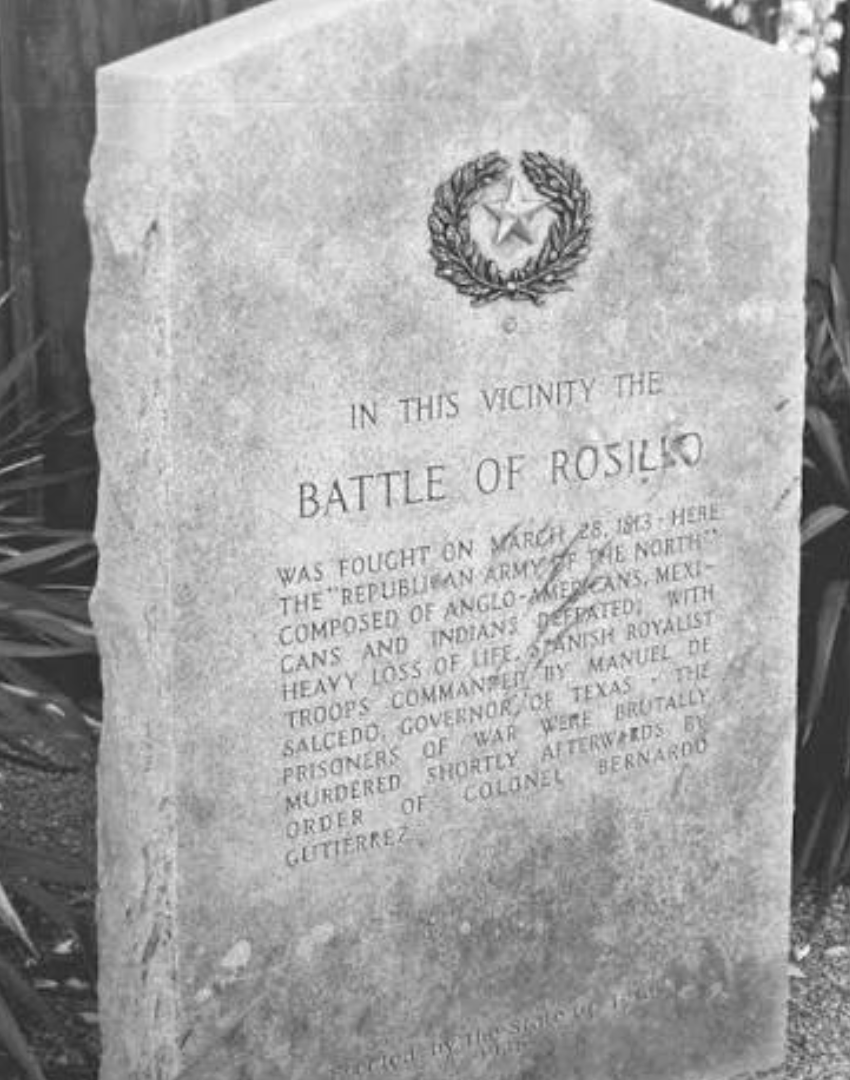
All the top Texas officials were slaughtered in a single morning in San Antonio, yet the city forgets. One spring morning in 1813, the Governors of Texas and Nuevo Leon were killed along with 14 other leading officials. The 1813 Battle of Rosillo altered the course of Spanish Texas. However, it is often overlooked in Texas history by the devastating Battle of Medina in 1813 and infamous fights like the Battle of the Alamo in 1836. Yet, for the growing city of San Antonio, this battle represents a defining moment in the city’s history, with the battle taking place just nine miles southeast of the former city limits. It is time to return that battle to public memory for a city that defines itself by its battle history.
In 1813, Texas remained under Spanish rule, but it had become a battleground during the decade-long Mexican War of Independence. Republican revolutionaries, known collectively as the Republic Army of the North, fought Spanish Royalist forces in a fierce campaign to overthrow Spanish authority and establish an independent government in Mexico. On March 29, 1813, Spanish Royalist forces led by Texas governor Manuel de Salcedo and Nuevo Leon Governor Simón de Herrera faced a devastating loss to the Republic Army of the North. A prior skirmish led them to seek refuge in San Antonio. Here, they devised a plan to ambush the Republican forces. Instead, the Royalists found themselves outmaneuvered. The Republican forces became aware of the Royalists’ plans and engaged them in the swift and brutal Battle of Rosillo, where the Republicans took their livestock, ammunition, and weapons.
The forces under Herrera and Salcedo suffered catastrophic losses, while the Republicans lost only six men. The surviving Royalists fled back to San Antonio, where Republican forces would soon march. Salcedo and Herrera surrendered, expecting to be treated as prisoners of war, but what they suffered violated traditional wartime customs and treatment of POWs.
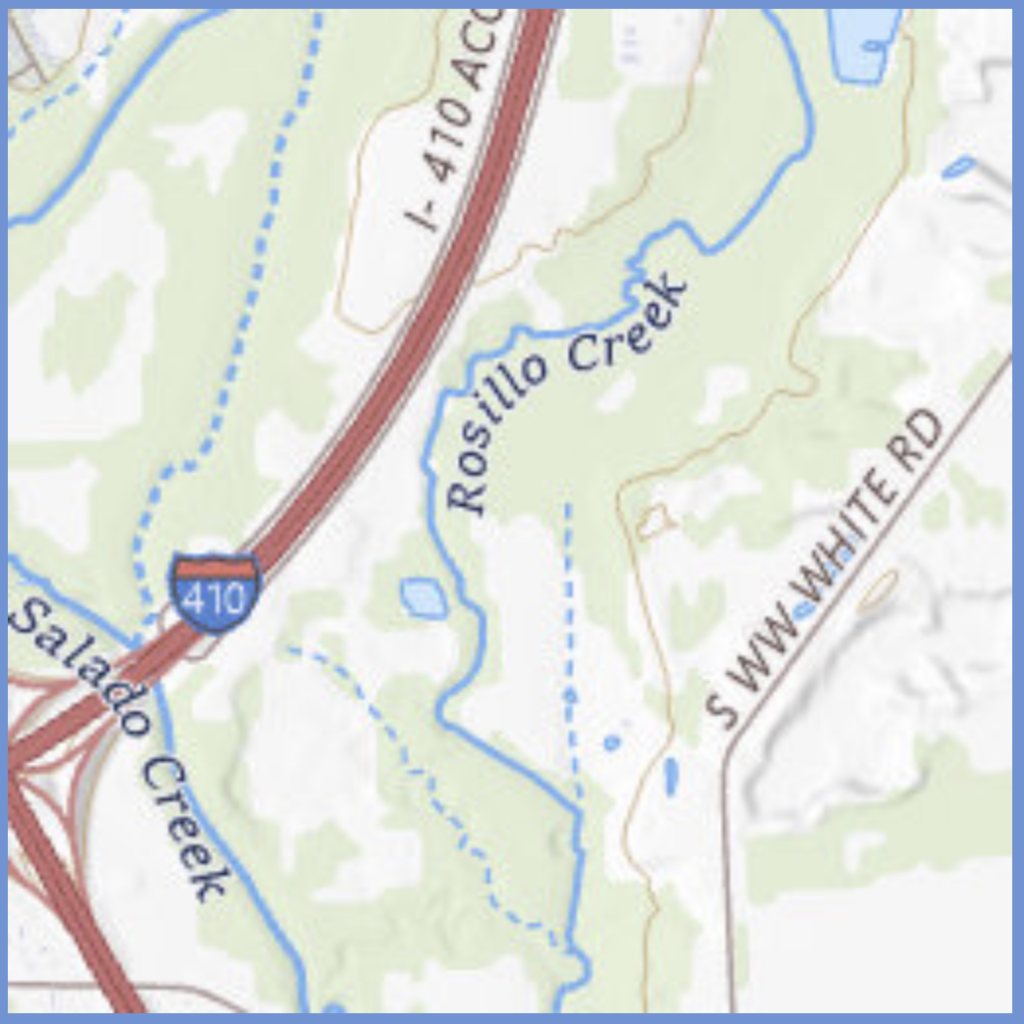
On April 3, Captain Antonio Delgado led some 60 Republicans in what became a massacre of the Royalist officers and authorities. Pretending to take them to New Orleans to be released, the victorious insurgents led the Spanish colonial authorities to a prairie near the junction of Rosillo and Salado Creeks, east of downtown San Antonio, where they slit their throats. According to the memoirs of young eyewitness José Antonio Navarro, they returned with the Royalists’ bloody insignia swinging from their saddlehorns, boasting of their retaliation for Royalist atrocities, including the murder of Delgado’s father. Although this brutality was remembered by some historians, the details of the officers’ burial have remained unknown until now.
Catholic Burial in the Old Camposanto
Thanks to the recent discovery of the San Fernando Church archives, we now know that these men were given a proper Catholic burial in the Old Camposanto cemetery, located where Milam Park and the Santa Rosa Children’s Hospital stand today. Anyone who drives down the block of Houston Street between the park and the hospital drives over the bones of San Antonio’s dead. Their Catholic faith allowed them to be laid to rest there among hundreds of other men and women and children of San Antonio buried from 1808 to 1860. While it is confirmed that Salcedo and Herrera were victims of the April 3 slaughter, the names of the soldiers who fell with them had been lost over time. Burial records of the Camposanto, however, allowed us to remember their names. Did they die during the Battle of Rosillo, or were their throats slit later? We don’t know. We do know that these men gave their lives to the Loyalist cause:
- Gregorio Amador, Spanish, Lt
- Francisco de Arcos, Spanish, 2nd Lt
- Luis de Arcos, Spanish, Lt. From Santander, Mexico
- Miguel de Arcos, Spanish, Lt Col. of the military, died with his two sons Francisco and Luis
- Juan Ignacio Arrambide, Spanish, Captain of the military, from the Alamo de las Parras
- Juan Caso, Spanish, Lt., from Nuevo Leon, Mexico
- José Goseaschocha, Spanish, Lt. Col
- Geronimo de Herrera, Spanish, Col
- Simón de Herrera, Spanish, General of the Eastern Providence
- Antonio Lopez, Spanish, Lt
- Bernardino Montero, Spanish, “killed at the battle of Rosillo and died like a true patriot”
- Francisco Pereira, Spanish, retired military captain
- Manuel de Salcedo, Spanish, “Governor of this Capitol”
- Manuel Sosa, Spanish, soldier, corporal, volunteered to fight and was killed by insurgents at the Battle of Rosillo Creek
- Joaquin de Ugarte, veteran from the Aqua Verde company
- Juan Echevarria, Spanish, Captain
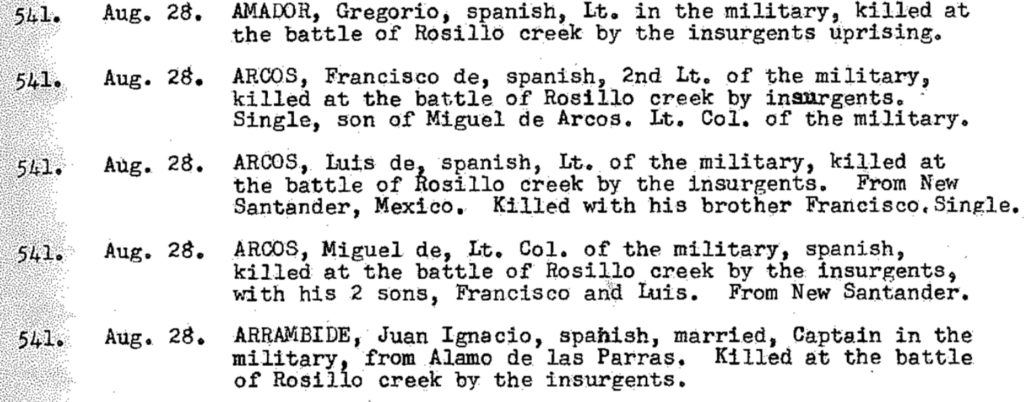
These soldiers reveal that the Loyalist losses at Rosillo extended beyond just prominent leaders such as Manuel de Salcedo and Simón de Herrera. These men dominate this historical account, but the Camposanto records illuminate the broad network of soldiers and officers who suffered during the Battle of Rosillo. From the records, it is shown that those who perished were lieutenants, captains, colonels, and enlisted soldiers. It should not just be Salcedo’s and Herrera’s names that are remembered, but these brave soldiers as well.
The database also reveals personal tales often absent from traditional battle narratives. Here we uncover the death of Miguel de Arcos, Lieutenant and father, who died alongside his two sons, Francisco and Luis de Arcos. Another set of brothers were Simón de Herrera and Geronimo de Herrera, both identified as Spanish, born in the Canary Islands. They had another brother, Pedro de Herrera, who at the time was the military commander of Monterrey, so his throat was not slit alongside his brothers. Through recovering these names, the index has transformed the Battle of Rosillo from military history centered on political figures to include the tragedy suffered by individuals as they witnessed their sons and brothers die in the violence of Mexico’s War of Independence.
One odd detail is the date and place of death recorded by the priest in the burial record. Though they were “degollados” (slaughtered) in early April 1813, they were not buried in the cemetery until late August 1813, nearly 5 months later. That means that their bodies lay unburied throughout the summer heat. Moreover, even though they were slaughtered at Salado Creek, the priest recorded the Battle of Rosillo (Rosillo Creek) as the site of their death. What happened here?
What we do know is that the Royalist officials’ burial was delayed for months. Not until the Spanish colonial authorities recaptured San Antonio over four months later could the bodies be laid to rest. Royalists did not win San Antonio back until August 18, when Joaquin de Arredondo hugely defeated the “Republican Army of the North” at the Battle of Medina. Nearly 1200 men died that day, most at the battlefield, but 400 were marched back to San Antonio and executed in Plaza de Armas just west of San Fernando Cathedral. After Royalists resumed control of San Antonio, they ordered the retrieval of the remains of the Royalists slain at Salado Creek and gave them a proper burial.
The priest who recorded their burials was sympathetic to the massacred Royalists, as we see in his tribute to the honor of some. He chose to credit their last formal military battle at Rosillo to spare them the indignity of their ignominious deaths and long exposure unconsecrated. He may also have been sparing their loved ones the suffering of that knowledge or masking the importance of Catholic pro-Royalist officials to bury them for months while insurgents ruled San Antonio. Recording that these men had been executed by insurgents could have further dishonored their memory and exposed their families to the harsh reality of their execution. By altering the date and place of their deaths, this San Fernando priest may have been taking an extra measure to honor the deceased and their efforts for the Loyalist army, even though he could not misrecord their burial date in the official Camposanto records. It is also possible that their remains were buried behind the original altar, long since remodeled, but that report remains unconfirmed.
Beyond these 16 officials and the stories of their deaths and burials, the suffering must have spread to their families, as revealed in their personal stories. José Manuel Goseascocha (aka Goceascochea) belonged to the wealthiest family on the Rio Grande. His wife was one of the main heiresses to the Espiritu Santo Grant, originally 59 leagues (over a quarter of a million acres). Goseascochea’s daughter, Estefania, inherited all the land that is now Brownsville and several other border towns. His grandson, Juan Cortino, resisted the Anglo takeover of the Rio Grande in the 1850s so strongly that Texas Rangers rode out from San Antonio to fight him. Born in Spain, José Manuel had served in the role of negotiator and peacemaker during the fight for freedom from Spain in 1813. His throat was slit, but his family continued to play major roles in Texas history for 50 more years, mostly losing to new settlers in Texas. These are the kinds of stories that this dataset reveals.
Even greater than the tragic deaths of these 16 officials is the retaliation prompted by this violence. Spain commanded Joaquín de Arredondo to march to Texas to avenge the royalists’ deaths. Not only did he defeat the insurgents, killing some 1200 men, but Arredondo then captured the insurgents’ wives, sisters, and mothers and confiscated their homes and property. The women were imprisoned for 54 days, forced to make tortillas for the very men who had just killed their loved ones while their children roamed the streets hungry and orphaned. Stories such as these are what make the information in the Camposanto critical to the history of San Antonio.
The Battle of Rosillo deserves to be remembered alongside the other defining battles of Texas history. The Camposanto records move us one step closer to commemorating those who gave their lives for their respective causes. The database allows for their sacrifices to be remembered after almost two centuries of erasure.
The soldiers of the Battle of Rosillo were fathers, sons, brothers, officers, and foot soldiers, but together they fought valiantly, and together they died tragically. Remembering these men does not diminish the famous Battle of the Alamo or the Battle of Medina. Instead, history makes room for remembrance of battles big and small and enriches our understanding of history. By preserving their names and stories through the Old Camposanto database, their legacies can be restored, and the burial of this history can finally rise to the surface.
References:
Leal, John Ogden. Camposanto: An Ancient Burial Ground of San Antonio, Texas, 1808–1869. San Antonio, Texas. San Fernando Church Records, 1975, San Fernando Church.
Thonhoff, Robert H. Association, Texas State Historical. “The Battle of Rosillo: A Pivotal Moment in Texas History.” Texas State Historical Association. Accessed July 22, 2026. https://www.tshaonline.org/handbook/entries/rosillo-battle-of
MacKenzie thanks St. Mary’s University for summer research funding (SURF). She also thanks the “Camposanto” research team for their collaboration: Dr. Lindsey Wieck, Cristal Mendez, Dr. Teresa Van Hoy, and Amariah Williams.
