By Trenton Boudreaux, Spring 2025
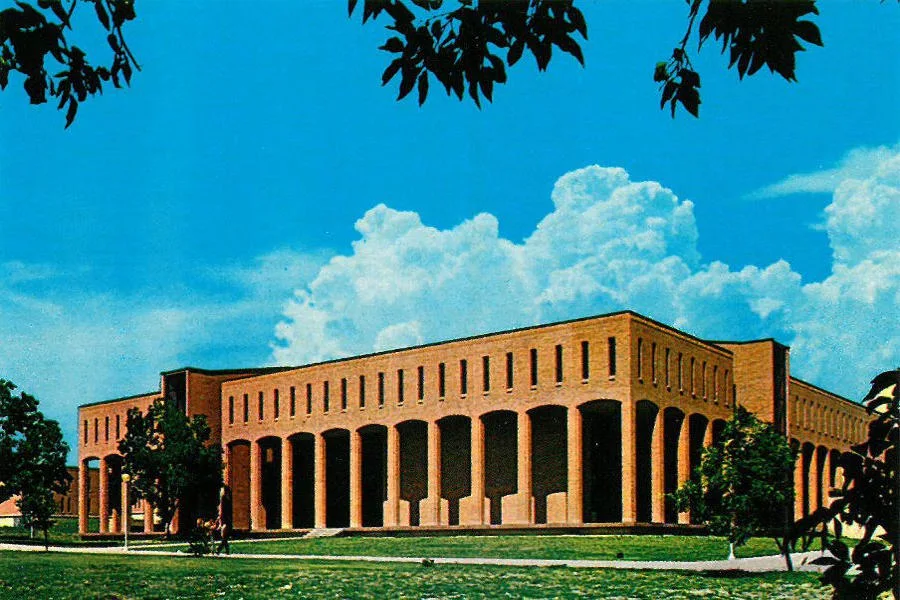
From February to May of 2025, I worked as an intern at the Blume Library. The Blume Library is the primary library for St. Mary’s University in San Antonio, Texas. Its mission states, “The Blume Library supports the mission of the University and the work of all members of the University community by providing appropriate resources to foster intellectual growth, welcoming environments that enable students and faculty to discover and integrate the many branches of human knowledge, and various types of assistance in scholarly endeavors.”
As an intern at the Blume Library, I worked in the back uploading metadata to the Digital Commons under Elizabeth Goode. The Digital Commons is the Blume Library’s repository for storing digital media.
For my first internship in the Fall of 2024, I uploaded videos of the President’s Peace Commission for the Digital Commons. These files had been converted to files from VHS Tapes. For my Spring 2025 internship, I worked on more diverse projects involving uploading metadata for a variety of different media styles.
First, I worked to upload files to the Black History Month collection, which highlights the stories, achievements, and contributions of African American students, faculty, and staff. For this, I downloaded and review the files Ms. Goode sent to me via email. These files were mostly magazine articles from either the Gold and Blue or the Gold and Blue: Law publications. I skimmed the articles for information on who the article was about when the article was written, and who wrote the article. I uploaded this data to the Digital Commons. I also searched the article for information on what topics the article covered and utilize this data to determine what keywords the article should use and what disciplines it fell under.

I also gave each article a description via a copied template. This template read “This article was featured in the [Season Year] issue of the Gold and Blue/Gold and Blue Law. It features the person the article is about. I found out the issue year and date for the articles by looking at the dates on the page, I would search the Gold and Blue articles already uploaded to the Digital Commons for the issue that contained the article in question to ensure the article was published in a physical Gold and Blue publication. If I couldn’t find it, I wrote in the description that it was an online-only article. From what I read in the articles, the people covered had a diverse array of stories. Whether that be an immigrant from the Congo becoming a Criminal Justice Major or an Alumna from Kenya becoming the country manager for Bata Shoe Kenya, PLC, the country’s largest footwear company.
I also uploaded similar metadata covering the McNair Scholar’s Program’s Research Symposium. The McNair Scholar’s Program is a program designed to help undergraduate students, especially those who are first-generation, low-income, or minorities, gain access to graduate-level education and receive doctorates. Like the previous database, I downloaded files from my supervisor. The files that were sent this time, however, were videos. I did not have to watch the whole video, instead I looked online at the McNair’s Scholars Research Symposium’s website on Kaltura, which is St. Mary’s primary online streaming service. I found the video recordings of the presentations on the Kaltura website and then copied the information that was on the webpage, which included the presenter’s name, a description of the presentation, the presentation title, and the keywords.
I copied and pasted this information into the Digital Commons as I uploaded the videos. Ms. Goode also sent me the cover image she wanted me to use, which I uploaded alongside the video rather than just using the first page of the PDF like the previous database. Also unlike the previous database, the files uploaded focused more on broader research topics, rather than on specific people. Still, the topics covered were rather diverse. Such topics include how sister cities can encourage more sustainable transportation, how intimate partner violence can impact the development of child witnesses if left unchecked, and how AI can optimize wind turbines.
The next series of files that I uploaded were from the Diamondback Yearbook. The Diamondback Yearbook was St. Mary’s University’s yearbook, containing photos of and information about the school. Like the previous collections, I received files from Ms. Goode, this time containing the cover images of each of the Diamondback Volumes. I was then expected to download the articles from the Portal to Texas History Website. The problem was, as I found, I didn’t have permission to download the files as PDFs. To counteract this, Ms. Goode suggested that I just link the uploads to the actual web pages for each Diamondback volume. For the cover image, I uploaded the matching Diamondback volume. As I was just uploading, I didn’t fully read each volume. However, I was impressed by how diverse the cover images were in design.

The next and shortest collection I uploaded were bio student lab reports and posters, of which I only had to upload two. Like previous collections, I had to read through some of the lab poster’s descriptions to understand what keywords could be gathered from the articles. I also copied and pasted the article descriptions. The method I had to record them was much different. For starters, I had to include an email in the author’s line, which wasn’t too complicated as I just copied and pasted the email Ms. Goode sent with the files I had to upload. I also had to add additional files which also wasn’t too difficult, however, I had to adjust my upload on the first attempt as I messed up the files I uploaded by uploading the entire folder that contained the three files for the lab report, lab poster, and lab report lab poster combined, before uploading each file individually, instead of just uploading the lab report + lab poster combined file as the file add on. Looking at the lab poster already uploaded by Goode helped me keep track of the steps I had to do and ensure I uploaded each part correctly.
I also uploaded links to the various St Mary’s Public History Project websites. This included projects that I had been a part of, such as Rattlers Remember, which discussed the various stories and histories of the university. It was a similar process to uploading the previous articles. However, I uploaded each website link as part of its own collection. For example, the Rattlers Remember website link was uploaded as part of the Rattlers Remember collection.
My final project was to upload articles from The Rattler. The Rattler is a bi-monthly student-run newspaper on campus, covering various topics. The Digital Commons already had parts of The Rattler uploaded, but I expanded upon it, going back to the earliest issues available on the Portal to Texas History Website. Doing so, I found articles from The St. Louis College Bulletin and The St Mary’s College Bulletin, which were published between 1919 and 1923. I asked Ms. Goode if I should upload these and she said that I should, considering that these could be two of the predecessor newspapers to The Rattler. I find it interesting that the name was changed so drastically, which makes me wonder why it was called the St. Louis College Bulletin when it was initially published. In any case, like the previous Diamondback yearbook database, I just pasted the individual links to the web pages, noting down the number of pages, the language, the volume, the issue, and the date. Unlike the Diamondback, I was asked to upload a generic cover image from the Portal to Texas History website.
The biggest lesson I learned from my internship was to be adaptable. I barely touched the President’s Peace Commission collection like I expected, and instead uploaded files to numerous different collections each with its own requirements. When I didn’t have any collections to upload to, I also did some odd jobs around the library. The one that took up the most of my time was link checking. Link checking entailed that I look through the journals list on the Blume Library website and ensure all the links to the sources work. This was my task whenever I was in between uploading projects before the Diamondback and Rattler projects became the new norm. When I first started link checking, I usually just clicked on a random letter and then go down the list of links, sending an email containing the ones that didn’t work correctly to another librarian, Ms. Katherine Thonen. Whenever I finished for the day and assuming I didn’t get another uploading task before the next day, I started over on a different letter. Ms. Thonen eventually recommended that I just stick to one letter whenever I checked links, so I claimed letter B as it was the first letter of my last name. I got to at least page 60 of the results before I was given the Diamondback Collection and the Rattler Collection to upload to the Digital Commons.
Another smaller task I had to do was to organize the President’s Peace Commission tapes onto a book cart. These were arranged according to their call number first, then the date they were produced. My method of organizing was to organize them based on the first number of the call number, and then the rest of the numbers determined their order further. For example, if I had two tapes with one having the call number B1460 and another with the call number B78, I would place B1460 before B78. This experience taught me the second major lesson of my internship, to be careful with how you organize both metadata and physical media. It turns out I was wrong to organize it in this way. I found this out when I had to do a later task in which I had to check to make sure we had all the VHS tapes that were on a certain list. When I first began checking, I was surprised by how many seemed missing from the list, and how many seemed to be on the shelf but not on the list. While I initially didn’t think much of it, I began to realize that some of the VHS tapes I knew I had uploaded were not on the shelf, according to how they were listed on the list. Instead, they were much later. I brought up these concerns with Ms. Goode, and she explained to me that I had organized them wrong and that some of the VHS tapes that were supposed to be on the bookshelf were not there. After Goode had reorganized them while I checked the link for a moment, I then went back to finish ensuring that all the VHS tapes were on the list, with the understanding that I needed to redo my call number training before starting work in a library.
Links to collections I uploaded parts of:
Black History at St. Mary’s University
Links to organization websites mentioned here:
