By MacKenzie Arendall
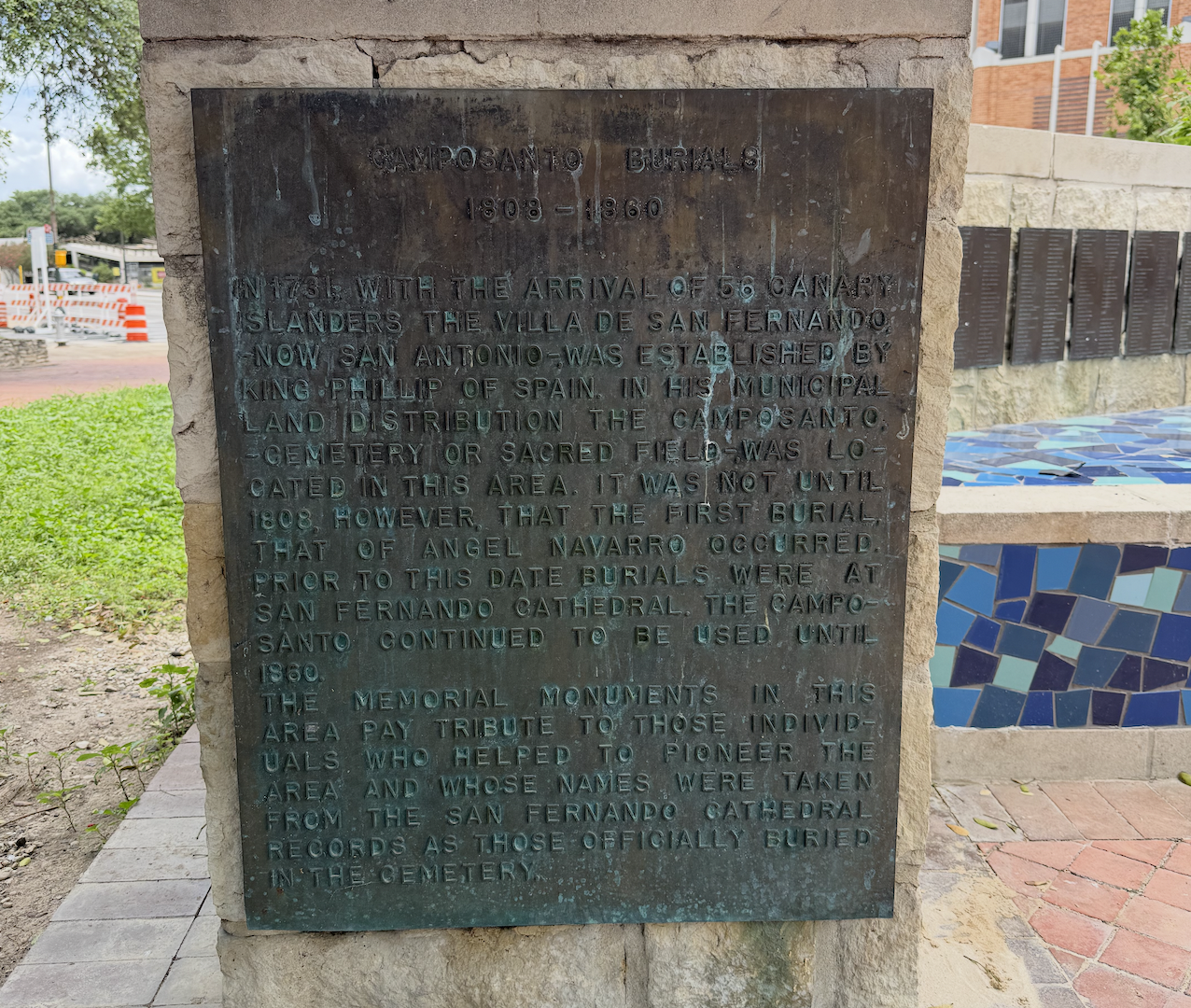
Every Juneteenth, we honor San Antonio’s enslaved foremothers and forefathers. This Juneteenth, let’s also name those whose bones remain to this day buried beneath Milam Park, Houston Street, and Santa Rosa Hospital. This summer, I have been utilizing records from the San Fernando archives to remember, preserve, and honor the memory of those listed as being buried in the long-forgotten Camposanto burial site. I found 18 ancestors enslaved, or freed from slavery, who were buried there. Their stories tell our story. Let me feature a few.
The youngest enslaved body belonged to Juan José Perez who died at birth. The oldest enslaved body belonged to Miguel, who was 100 years old. Newborn and Centenarian, both buried under our feet as we play in Milam Park, drive down Houston Street, or rush to Santa Rosa hospital.
Who were they? One single sentence-fragment survives for each ancestor. Priests of San Fernando parish scribbled a few words in the burial records, yet they reveal stunning glimpses of old San Antonio.
Newborn Juan José is registered as a “mulato” and as the “natural” son of María Policorpia Perez, “negress.” These three labels speak volumes about the world in which the baby died.
Each of these label’s points to a very real piece of these people’s lives: First, this infant lived less than one day, yet he probably would have been considered enslaved because babies inherited the status of their mothers. Second, mulato babies are part-white so the question is where did Juan Jose’s ancestry come from? Could it have come from friends or family of his mother’s enslaver, Maria Eslinda Bustillos? Third, “natural” means “illegitimate.” Because enslaved women rarely enjoyed the protections and honor of marriage, Maria Policorpia was unmarried, so her innocent infant bore the label of “bastard.”
A single kindness shines amid the tragic layers of mother’s life and son’s death. The midwife, Maria Hernández, sprinkled holy water on Juan José at birth, thereby making him eligible for burial in the sacred ground of the “Camposanto.”
Miguel died at age 100. Did he suffer one hundred years of slavery? We don’t know. He may have enjoyed freedom when Mexico abolished slavery in Texas in 1829, only to be doomed by the new pro-slavery Constitution imposed by Texans in 1836. Miguel is one of only two enslaved people buried in the old Camposanto whose enslaver was Anglo Texan. Miguel’s enslaver was John McMullen. McCullen was the founder of the Irish colony in Texas and Chief Justice of Bexar County. The other person enslaved by an Anglo was only a baby. José Antonio (no surname) was 11 months old and 19 days old when he died. José Antonio’s enslaver, John Smith, became mayor of San Antonio the year after his baby slave died.
Beyond San Antonio’s youngest and oldest enslaved ancestors buried in this Camposanto, let’s honor another moving subset of enslaved San Antonians: Blacks born in the South American country of Dutch Guiana.
Who are our ancestors born in Dutch Guiana and buried downtown under our park, street, and hospital?
The priests listed four Black San Antonians as natives of Guiana: Ana María de la Cruz, María de los Dolores, José Manuel, María de Josefa Santiago.
Were there only four forebears from Guiana? No. María Josefa’s parents were also Guiana natives because she was born in Guiana and she is labeled their “legitimate daughter.” If her parents, José Santiago and María Feliona, were Guiana natives (known as Surinamese), then perhaps other Surinamese natives might also have lived in San Antonio. Thanks to this Camposanto research, we can make the surprising discovery that at least 6 South Americans lived in colonial San Antonio… and perhaps more.
Were all four enslaved? Two of them are explicitly listed as enslaved. The two who are not listed as enslaved do, however, also lack surnames and ages (commonly omitted for enslaved people).
Why are Black natives of Guiana living in San Antonio in 1812-1814? The only link I can identify so far is a prominent Guiana-born resident who called himself Baron de Bastrop. He was born in Dutch Guiana in 1759. He later became a tax collector in Holland but fled to Louisiana to escape charges of embezzlement. In Louisiana, he faked a title of nobility, Baron de Bastrop, and won the trust of Spanish authorities in colonial Texas. Did Bastrop bring these enslaved people to San Antonio? It seems likely. He was living in San Antonio at this time, and he was an enslaver and a slave trader. We need further research to test my hunch that Bastrop trafficked Guiana natives. For now, I honor these four forebears buried in the Camposanto and commit to further research.
Thanks to this summer research, 18 San Antonians formerly enslaved or freed from slavery have been recovered from oblivion. We can now speak their names, commemorate their deaths, and tell at least some small part of their stories. How many other enslaved ancestors may have been buried beside them or elsewhere in San Antonio who are forever lost to history?
San Antonio loves celebrating history. Ironically, the Battle of San Jacinto that reinstituted slavery in Texas is celebrated annually here by a parade that originally ran right over this Camposanto. Perhaps the floats of the Battle of Flowers parade marching down Houston Street passed over the remains of these enslaved San Antonians?
Let us remember them by name:
- Santiago Gonzales: Mulato, free slave, #796, page 29
- Pedro Morales: Mulato, free slave, #692, page 26
- Manuela Maria [surname unknown]: Negro, enslaved, #671, page 26
- Jose Manuel [surname unknown]: Negro, enslaved, #604, page 21
- Antonia Gonzales: Mulata, free slave, #651, page 21
- Maria Dolores Caravello: Mulata, free slave, #623, page 20
- Ana Maria de la Cruz: Negro, enslaved, #519, page 15a
- Maria Lugarda Saldana: Mulata, free slave, #479, page 14
- Maria Rodriguez: Mulata, enslaved to Gabino Delgado, #405, page 14
- Juan Jose Perez: Mulato, died at birth, mother was enslaved to Maria Eslina Bustillos, #401, page 13
- Jose de la Candelaria [surname unknown]: Negro, 4 years old, enslaved to Clemente Delgado, #308, page 6
- Juan Jose Felipe de la Cruz: Enslaved child, #696, page 24
- Maria Ramirez: Native American, adult enslaved to Francisco Collantes, #718, page 27
- Maria Ignacia de Carmel [surname unknown]: Spanish, child of an enslaved Mulata woman, Maria Fabiana, #815, page 30
- Jose Antonio [surname unknown]: 11 months and 19 days old, enslaved by John Smith, #52, page 76
- Maria Regina [surname unknown]: 1 year old, enslaved, #113, page 79
- Miguel [surname unknown]: 100 years old, enslaved by John MacMullen, #142, page 81
- Mariana [surname unknown]: Enslaved to Jesus Cantu, #986, page 108
Each of these people is listed in the Camposanto burial record index, and this includes their name, age, status (if included), and where to find them in the records.
Notes: Clemente Delgado died in 1833 and was buried in the Camposanto. He was the enslaver to 4 year old Jose de la Candelaria [surname unknown]
MacKenzie thanks St. Mary’s University for summer research funding (SURF). She also thanks the “Camposanto” research team for their collaboration: Dr. Lindsey Wieck, Cristal Mendez, Dr. Teresa Van Hoy, and Amariah Williams.
